• The Sandpaper Year

    What Nobody Tells You About Following Your Passion

    As the year ends, I’m getting reflective. Specifically, about the gap between the dream and the doing.

    I moved to Sweden to pursue a master’s in strategic entrepreneurship. On paper: perfect. In reality: I’m working 20 hours a week as a Sales Manager for a German company while trying to build my own venture through the program.

    Ever since I found The Lean Startup by accident in our university library, I’ve been obsessed with entrepreneurship. Maybe because I’ve always rejected traditional paths. My brain naturally asks: “What if we ignored how it’s always been done?” Moving to Sweden was part of that, another escape from systems that never fit, like the German school system.

    Three months in, here’s what’s actually happening:

    The work reveals what you’re avoiding.

    Sales goes against everything in my personality. Twenty hours a week of pushing, performing, persuading. It feels completely wrong.

    But that wrongness is teaching me something. When you spend time doing what’s false, you recognize what’s true. The discomfort isn’t the obstacle, it’s the contrast that makes my real work visible. Maybe the job isn’t in the way. Maybe it’s the sandpaper.

    Academia might not be the answer.

    Thirty-five master’s students in my cohort. Not one inspiring conversation.

    At first, I blamed myself, maybe I’m not trying hard enough, maybe I’m too judgmental. Now I think: maybe I’m in the wrong room, and that’s information, not failure.

    Before this, I worked in Berlin’s startup scene, surrounded by people with more experience, different perspectives, actual scar tissue. They stretched me. Here, everyone knows as little as I do. We’re all equally inexperienced.

    The education I’m getting isn’t from the curriculum. It’s from the gap between what they’re teaching and what I already know to be true. That gap is where my actual work lives.

    Boredom is where the signal emerges.

    Moving to an 80,000-person town in the middle of Sweden gave me something Berlin never could: the absence of everything else.

    No warehouse raves. No FOMO about tonight’s event. No constant stimulation disguised as opportunity.

    What’s left is uncomfortable at first. Then it becomes clarity.

    I started meditating because my head felt like chaos I couldn’t control. Now it’s my favorite practice, not because it solves anything, but because it creates space for things to settle. The mud has to settle before you can see through the water.

    Flow is a compass, not a destination.

    Ninety percent of my day is forcing myself to do hard things: sales calls on a schedule, assignments I don’t care about, other people’s priorities. Time crawls.

    But when I work on what actually interests me, this writing, the book I’m building, art work, time disappears. I’m not watching the clock. I’m in it.

    I’ve learned to trust that disappearance. Flow isn’t just a pleasant state, it’s directional for me. It points toward what’s real for you.

    My brain doesn’t work linearly, so I stopped forcing it to.

    I keep 2-3 projects open at once: this blog, a book, Adobe. When I’m stuck on one, another one calls to me. I used to fight this, thought it was distraction, lack of discipline.

    Now I follow it. The mind knows what it needs. When I’m focused on one thing, my brain works on the others in the background. Suddenly an idea arrives, and I switch. The flow continues.

    Csikszentmihalyi said flow happens at the edge of challenge and skill. But there’s another element: timing. The work knows when it’s ready. Following that timing isn’t distraction, it’s listening.

    The gap between expectation and reality is where you find your actual path.

    I came here expecting peers, inspiration, the perfect environment to build something meaningful.

    What I’m actually getting: isolation, doubt, friction, the daily grind of managing two competing demands.

    But here’s what I’m learning: the romantic version of following your passion and the real version are completely different.

    One is inspiration and flow and meaning. The other is discipline and sacrifice and showing up when you don’t feel like it.

    Most people quit when they hit that gap. They assume they chose wrong.

    I’m starting to think the gap is the path. What you thought you should want versus what you actually want, that tension is where your real work reveals itself.

    So what now?

    I’m not sure yet. But I’m learning to trust the discomfort more than the comfort. To protect my attention like it’s sacred. To let some balls drop and see which ones I actually chase.

    The program will end. The job will change. Sweden might not be forever.

    But the question underneath all of it Am I moving toward my own voice or away from it? that’s the only one that matters.

  • How to Use AI Tools to Amplify Your Creativity as an Artist (Without Losing Your Soul)

    Fear it or ride it—AI isn’t killing art.
    It’s mutating it.
    And if you learn how to wield it, your most mind-bending work may still be ahead of you. Because now the entry barriers to digital art are as low as ever. And you can either hate it or harness this new world of opportunities and change.

    First, I will give you a brief overview on the tools I use as I find that the sheer amount of GenAI producing software can be overwhelming. However, I have to warn you that the LLM models are evolving lightspeed and therefore the image generation as well.


    Prompting 101:

    Adjectives are your paintbrush.
    The more specific your vision, the more the machine mirrors it.

    Example:
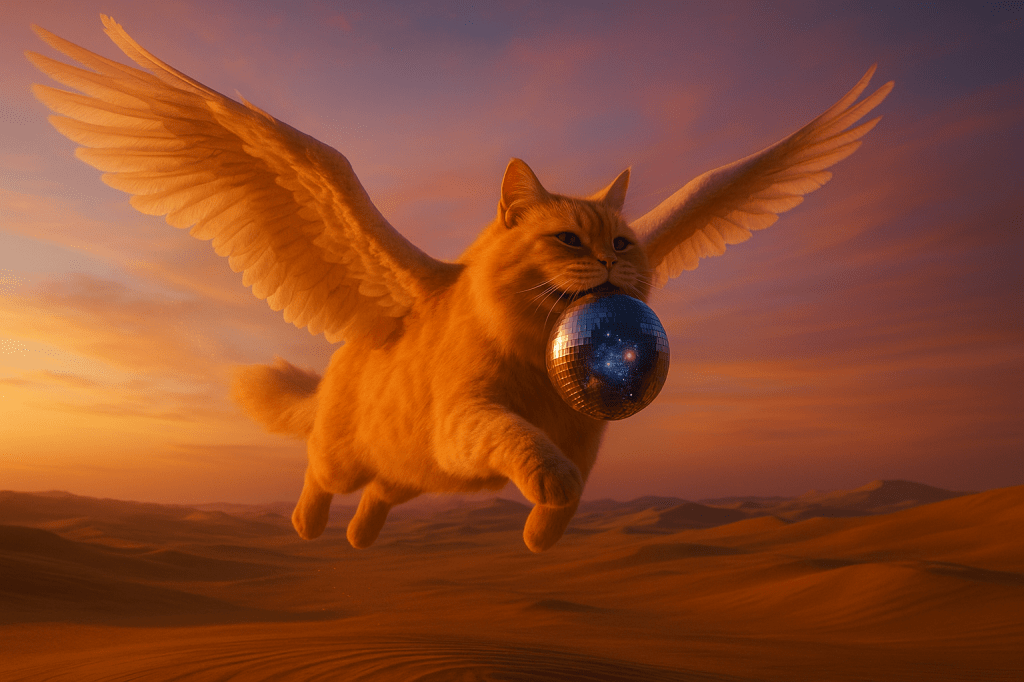
    A hyper-realistic cinematic still of a massive, bus-sized golden-orange cat with soft, plush fur and vast angelic wings, soaring just above a golden desert at sunset. The cat appears joyful and majestic, its face lit by the warm hues of twilight. In its mouth, it gently carries a perfectly reflective disco ball—small in scale compared to the cat, but glowing from within, revealing an entire spinning miniature universe inside. Planets slowly orbit within it. Stars twinkle. Nebulae pulse in soft pinks and cosmic blue. The sky above the cat is a surreal blend of amber, rose gold, and rich lavender, capturing the sun’s last descent. Below, the desert dunes ripple like an ocean of golden silk, catching the warm light. The cat’s wings are vast and feathery, semi-translucent, shimmering with hints of iridescent lavender and pearl as the sunlight filters through them. A faint trail of desert wind and stardust swirls in its wake. Shot on an ARRI Alexa Mini LF with a 35mm anamorphic lens, cinematic aspect ratio (2.39:1), shallow depth of field, and high dynamic range color. The camera angle is low and dynamic, following behind and slightly below the cat, emphasizing scale and motion—evoking awe and surreal beauty. The scene blends ultra-realistic fantasy with dreamlike sci-fi, reminiscent of Denis Villeneuve’s ‘Dune’ fused with the surreal wonder of ‘Interstellar’ and the playful charm of Studio Ghibli.”

    Try this:

    • Love a certain artist? Try their style on something totally unhinged. A modern Monet about heartbreak, near a waterfall. Seawater lilies in a rooftop pool. Or upload a picture from your camera roll and remix it as a Dali painting.
    • See something stunning? Photograph it, upload it, prompt from it. Color-match a stranger’s sari. Remix a sunset into fabric texture. Let the real world feed the machine.
    • Build a reference bank. I document things that move me. Saw a Picasso, loved the palette. Fed it into Midjourney, rewrote it into a character. Inspiration is a loop.

    Tips for Getting Weird (In a Good Way)

    Detail is the difference. Treat your prompt like cinematography. Shot on a 2000 Kodak disposable. Film grain. Harsh flash. Yellowed border. Coffee stain. Mood, era, moment. The more specific you are, the better. Whatever details I leave out are mostly disappointing because the intended picture will look different from the vision.

    As in my previous example, use lens language. Photographers might have an advantage here. Angles, shots, moods, the camera model being used. It gives the AI something real to work on.

    Also, look at what others are making. Sora’s explore page? It’s a rabbit hole of what’s possible. You have the option of copying a prompt and adjusting the parts that you don’t like. I highly recommend this one.


    New Creative Rituals for the AI Era

    We’re not just making art anymore.
    We’re inventing new ways of making.

    AI isn’t just a tool. It’s something we’re learning to move with. Like a partner in a dance we’re still figuring out. And if we treat it like just another app, just another shortcut, we’re missing the point.

    What’s happening now is deeper than workflow. It feels like ritual.

    There’s something about how we engage with these models that invites new practices. Not just productivity hacks, but quiet, weird, personal rhythms. Ways of making that are both fast and slow. Machine-assisted and deeply human.

    Some people are printing out AI images and collaging them by hand. Others are painting over Midjourney generations, turning digital files into tactile objects. Some are doing live prompt sessions like performances, improvising in real time. Even saving your best outputs and prompts becomes its own kind of practice—a sketchbook, a moodboard, a breadcrumb trail for your future self.

    My favorite is translating AI into analog. Not stopping at the screen, but letting it push you back into the physical world.

    Start with a Midjourney prompt like:

    A teenage girl in Ramallah, disposable camera photo from August 12, 2003. Rooftop evening. Olive trees in the distance. Plastic patio chairs. A faded red water tank. Cousins playing cards on a woven mat. Faint Arabic music from a radio. Warm light from a bare bulb. A plate of watermelon slices. Sandals kicked off. Scratch on the lens. Dust in the air. Yellow date stamp: “12/08/03 20:17.

    Let the AI get you 80% there. Then try to recreate it yourself. By hand. With a camera. With paint. With whatever medium you trust.

    Texture is time travel. The machine gives you the scaffolding, but the final 20%—the soul of it—that’s on you.

    This moment isn’t about whether AI can make art. It already can, sort of. The real question is: what do we do now? How do we respond? How do we stay weird and honest and alive in the face of infinite generation?

    We don’t need to speed up. We need to root deeper. Pay attention. Make it real.

    We’re not creating with AI. We’re creating through it. And that’s where the magic is.


    Not Just a Tool—A New Kind of Collaboration

    Don’t just use AI. Dance with it.

    This isn’t about command and control. It’s not a vending machine for art. It’s something stranger, more fluid—a creative partner that responds to emotion, curiosity, even chaos.

    Start with a feeling. Feed your longing, your memory, your ache into the prompt. Be specific. Be weird. Let the machine mirror something back that surprises you.

    Treat the output like a rough sketch. It’s not the answer. It’s an invitation.

    Remix it. Rip it apart. Print it out and scribble over it. Paint it, photograph it, burn it. Let your body into the process. Let your taste make the decisions.

    When you get stuck—introduce randomness. Swap words, break the syntax, throw in something absurd. AI is especially good at helping you get lost in the right direction. And sometimes absurdity is what cracks things open. The uncanny makes the familiar feel new again.

    This isn’t about letting the machine do the work. It’s about letting it destabilize you just enough that something unexpected can happen. A new direction. A new feeling. A new ritual.

    We’re not outsourcing creativity. We’re expanding it.


    The Bigger Question

    If beauty is an emergent property of symmetry and surprise,
    then yes—artificial minds can derive aesthetics from first principles.

    But is that enough?

    An artist friend once told me: “Art without meaning is decoration.”
    Technique alone doesn’t move us. It’s the intention behind it. The soul.

    So can a brush with no soul create a Guernica?

    Wrong question.

    The more interesting question isn’t whether AI can be human—
    it’s how we evolve as artists in a post-human world.

    I want to compose symphonies with GPT-9 that senses my mood through my pulse.
    I want clothing that shifts with my emotional frequency.
    I want galleries that respond to my breath, my pace, my gaze.

    We’re not here to compete with machines.
    We’re here to collaborate with them—
    to let them pull us into new modes of perception, new rituals of making.

    This is the next movement in the symphony:

    Man creates machine.
    Machine redefines man.
    We orbit our creations as much as they orbit us.

    And in that gravity, something new emerges.

    Not artificial.
    Not human.
    Just… art, again.

  • When the Muse Went Machine: Art in the Age of AI
    (How I stopped fearing Midjourney and started using it like a psychic brush)

    Art used to be a sacred ritual.
    You’d light your candles. Gather your brushes. Pick your favorite spatula. Maybe you had a playlist. Maybe you painted in silence. But it always began the same way: with you. Your emotions. Your mess. Your desire to transform it into something real.

    You’d plan to paint a sunset, but then—bam—intuition takes over. You’re smearing fat streaks of pink across a stranger’s face like you’re possessed. You abandon the “plan” because something else has taken over.
    That?
    That was the divine moment.
    That was art.

    But where did it go?


    The Algorithm Has Entered the Studio

    Now… we type.
    We prompt.
    We scroll.
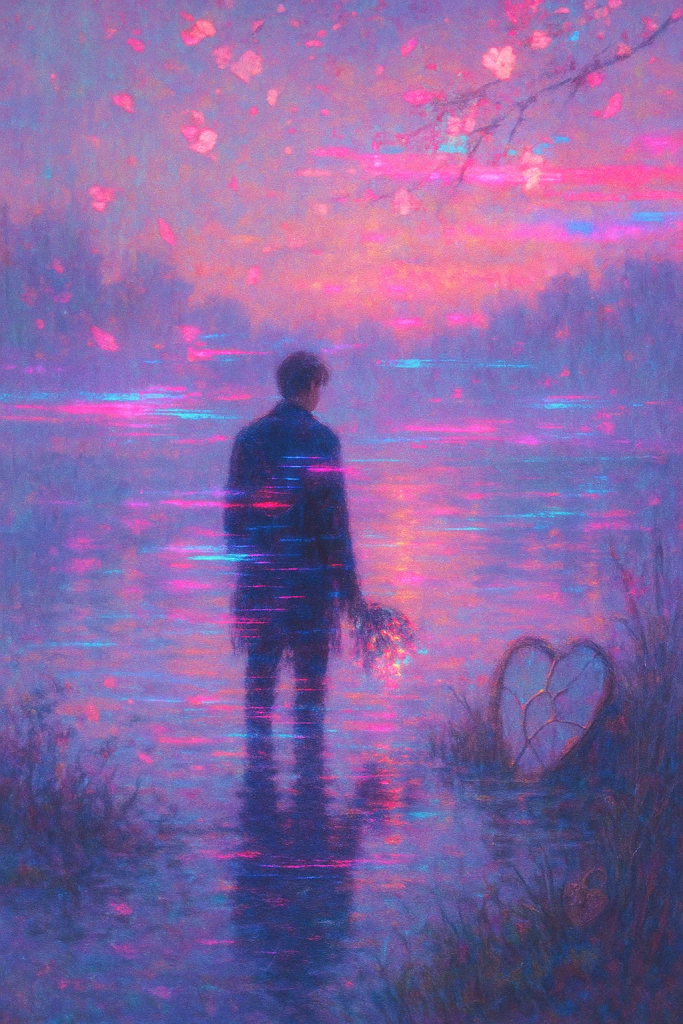
    We ask machines to “give us something beautiful” in the style of Monet meets neon glitchwave with a touch of heartbreak.

    And honestly?
    It delivers.

    AI-generated art is fast. It’s impressive. It can be heartbreakingly accurate.
    And yes, it’s changing the game.
    But it also begs the question:
    Where the hell does intuition live in a world where creativity is automated?


    Rethinking the Ritual: What If AI Isn’t the Death of Art—But the Expansion of It?

    Look. I get the fear.
    Every time something big shifts—whether it’s how we work, date, think, or make art—we panic.
    We grieve the old world.
    But what if this isn’t the end?

    What if the ritual just changed?

    What if we still made room for that subconscious magic—but instead of mixing pigments, we’re mixing modalities?


    Here’s What I’m Dreaming Up:

    • You’re heartbroken. You feed your pain into Midjourney. The output isn’t your final piece—it’s your starting point. You print it, and then paint over it. The machine gives you shape, but your brush gives it soul.
    • You write a strange little scene with ChatGPT, something surreal and disturbing. Then you perform it—à la Marina Abramović—because it disturbed you. The AI becomes your sparring partner in a performance ritual.
    • You build a new art style that’s AI-assisted but unmistakably yours. Think Van Gogh in the age of neural nets. Think signature glitches. Think emotion trained into an aesthetic no machine could copy without your essence baked in.

    The Rise of the Intuition Technologist

    Here’s the truth nobody wants to say:

    The artists who will thrive in this new era won’t be the ones who cling to traditional skills like life rafts.
    They’ll be the ones who translate their internal chaos into new tools, new methods, and new styles.

    Your job isn’t to paint like you used to.
    Your job is to discover how the same emotions—grief, lust, obsession, joy—can be extracted through machines.

    Not to replace the muse.
    But to amplify her.


    But What About Authenticity?

    Yes—handmade art will become fetishized.
    It’ll be the new “analog luxury.”
    Collectors will brag that a painting was made without any AI intervention. It’ll be a flex.

    But authenticity is a moving target.
    Today, it’s canvas.
    Tomorrow, it’s intention.

    Did you make something only you could have made—machine-assisted or not?
    That’s what will matter.


    So What Now?

    We’re entering a strange and beautiful era.

    The entry barrier to “good” art is lower than ever.
    By the law of large numbers, this means some of the most extraordinary art in history will be born right now.
    In basements. On borrowed laptops. With models trained on dead artists and live pain.

    And YOU?
    You get to decide what kind of artist you’ll be in this era.

    Curator? Alchemist? Collaborator?
    Or will you cling to an old ritual that no longer exists?


    Final Thought

    Creativity isn’t dying.
    It’s mutating.
    And maybe, just maybe, that’s exactly what art has always done.

  • The Age of the Artist Is Over. Welcome to the Era of the Curator.

    AI has automated execution.

    You used to need skill to bring an idea to life. Now you need taste. In a world where you can build anything in minutes, the real power lies in knowing what deserves to exist.

    The internet is already overflowing—overflowing-er now, if that’s possible. AI tools have turned content into a firehose. Whatever you can dream, you can make. Instantly. That spark of an idea? A few prompts later and it’s dressed, lit, rendered, ready for export.

    The bottleneck has shifted.

    It’s no longer how to make something.
    It’s what to make—and why it matters.

    “Art is beautiful, but it’s a lot of work.” – Karl Valentin
    This quote used to hang in the art room back in school—charming then, but it hasn’t exactly aged like fine wine.

    Idea generation? Easy.
    Execution? Instant.
    Strategy? Prompt-to-publish.

    The question now is: What makes the cut?
    What’s worth finishing? Sharing? Obsessing over?
    What’s not just possible to make—but necessary?


    The thrill of skipping the hard part

    When I first started using Midjourney, I was drunk on possibility.

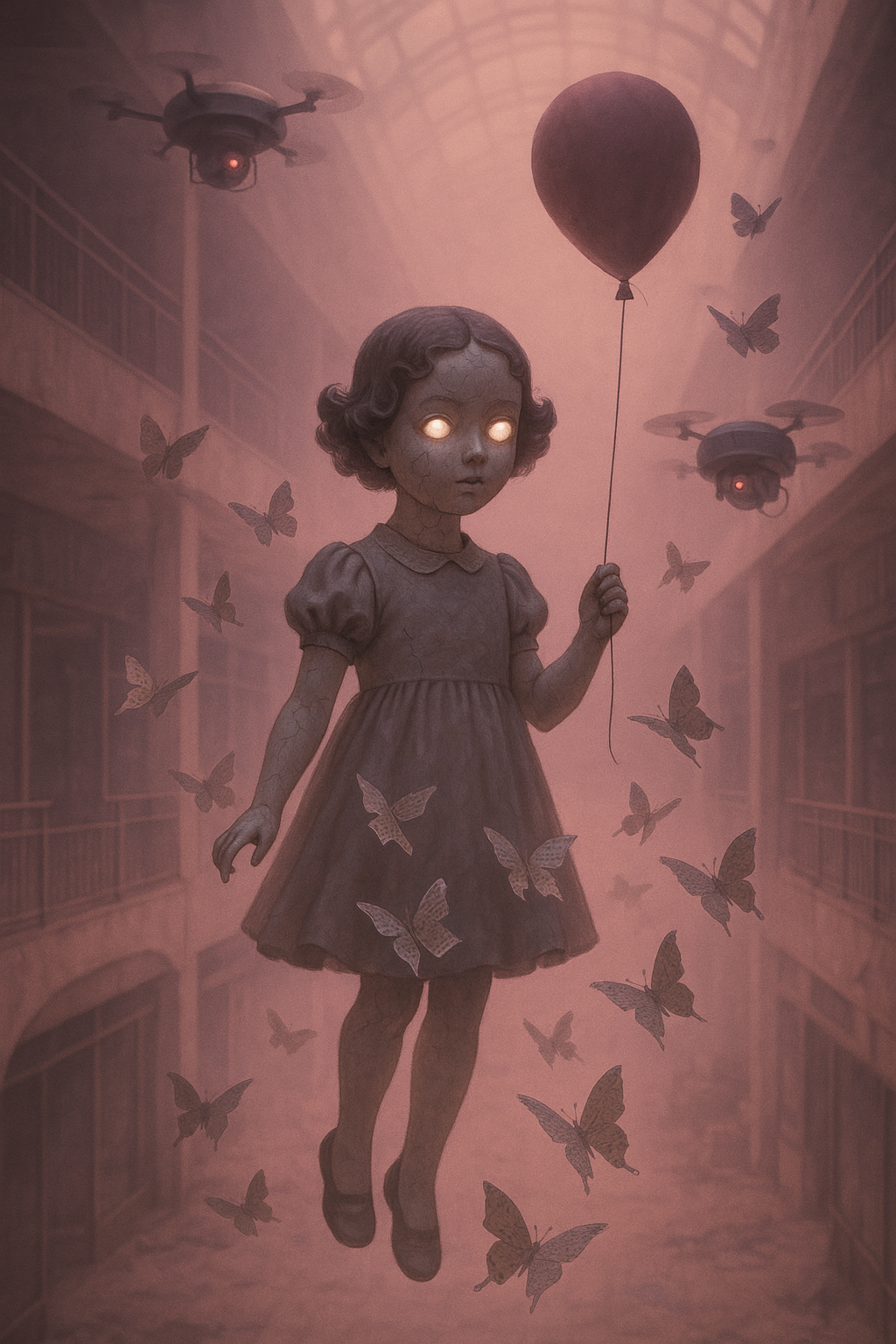
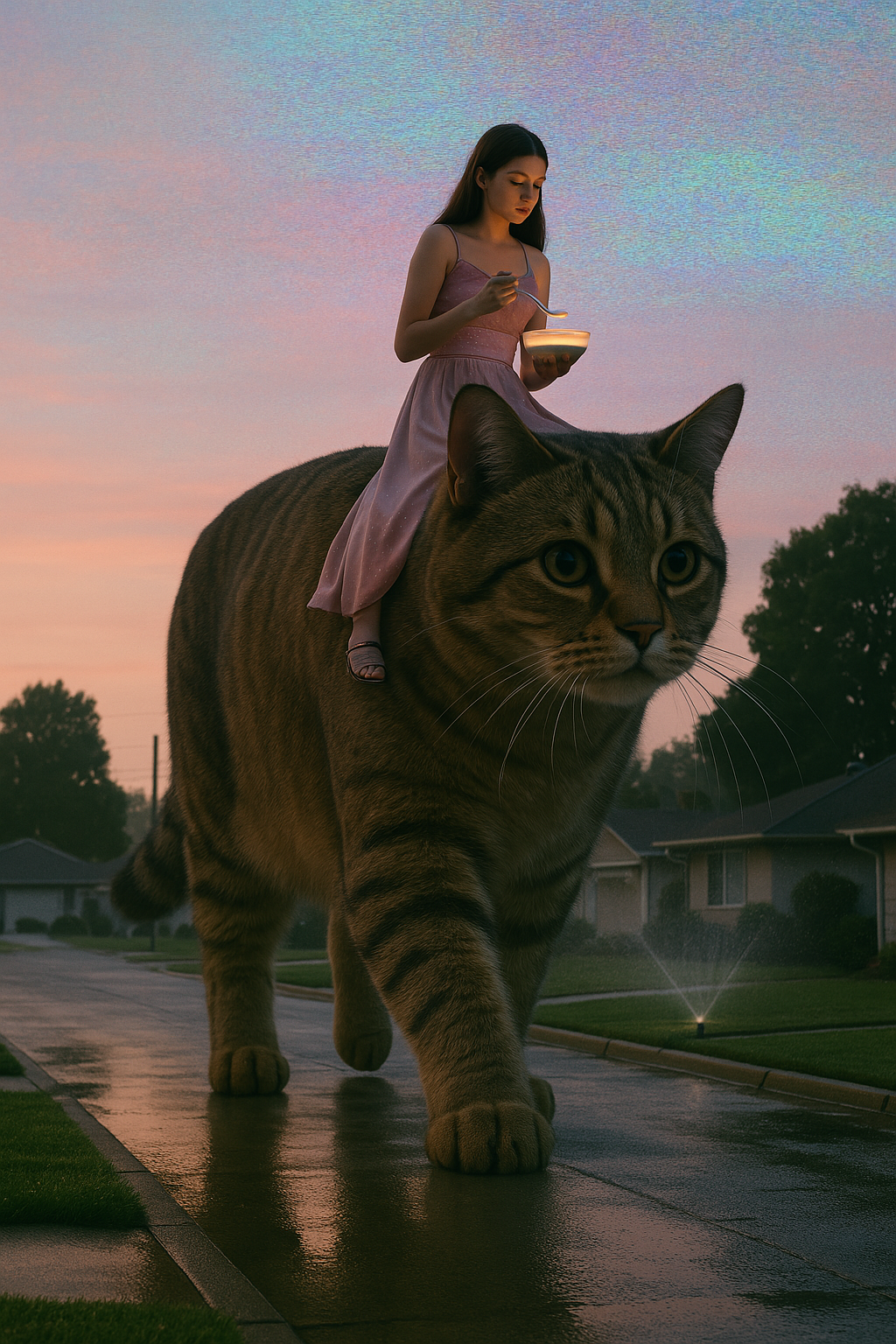
    In seconds, I could render the images in my head: A porcelain girl with glowing eyes floats through an abandoned shopping mall flooded with soft pink fog. A giant house cat the size of a city bus slowly walks through a quiet suburban neighborhood at dawn. No one reacts. A teenage girl in a prom dress sits calmly on its back, eating cereal from a glowing bowl. Weird, vivid, impossible stuff—and suddenly, it wasn’t just in my brain anymore. It was real. Tangible. Shareable.

    At first, it was intoxicating.
    Then… a little disorienting.

    Because something was missing. There was no struggle. No blank page. No hours of pushing through creative paralysis, no breakthrough moment after a block. Just… a very good result. Instantly.

    That thrill flattened into something else: a quiet unease.

    If everyone can make beautiful things now, what does beautiful even mean? Where does value live when output is infinite?


    2. Execution has been commodified

    Let’s be honest: AI didn’t just speed up creativity—it democratized excellence.

    You no longer need years of technical skill to produce something impressive. You just need the right keywords, a good eye, and a decent bullshit filter.

    So now, the real challenge isn’t execution. It’s selection.

    What’s worth making? What’s worth keeping? What’s you?

    Every one of us is becoming the curator of our own infinite museum. We’re swimming in content, tools, prompts, templates, presets. And somewhere in that flood, we have to make choices—ruthlessly. Thoughtfully. Maybe even weirdly.

    But choice is exhausting. Decision fatigue is real. And still: this is where the game is won.


    3. The new creative class: curators, not craftsmen

    Before AI, the “elite” creatives were defined by craft: drawing, coding, composing, building. Now? The edge is in choosing, imagining, refining, remixing.

    Designers feed their moodboards into gen models.
    Writers spar with ChatGPT to chase ideas in odd directions.
    Developers prompt Cursor like it’s a mildly sassy assistant.
    Filmmakers use AI to previsualize entire storyboards before lifting a camera.

    It’s less about being a solo genius, and more about being a hyper-collaborative, tool-savvy director of vibes.

    You’re not writing a novel. You’re sculpting a narrative out of raw noise.
    You’re not painting a picture. You’re tuning an aesthetic frequency only you can hear.


    4. The danger: sameness, mimicry, over-optimization

    But here’s the risk: if everyone uses the same tools, everything starts to look the same.

    Same aesthetic. Same music. Same shiny, hyperreal, too-slick outputs.

    We risk flattening the soul out of the work—turning creativity into content, story into spectacle, beauty into vibe-checked asset packs. Optimization becomes mimicry. Good taste becomes conformity.

    And that’s the trap.

    Because the goal of art isn’t to look good. It’s to hit. To move. To haunt.

    That’s not something AI can do alone. That’s where you come in.

    You—the editor, the curator, the final set of fingers making that last brutal cut. You’re the one who knows what doesn’t belong. Who can smell when something’s too clean, too safe, too easy.


    5. The Real Differentiator: Constraints, Weirdness, and Signature Moves

    When anything is possible, taste becomes the final frontier.

    The edge now isn’t in output—it’s in filters. It’s in how you twist the tools, what you obsess over, what you insist on.

    Not “what do you refuse to make?”

    No.
    What do you keep making even when no one asks for it?
    What makes people say, “This could only come from you”?

    A designer who strips out all color—because grayscale feels truer than palette.
    A writer who uses AI to simulate arguments with their inner critic.
    A musician who generates ambient noise and sings over it in one-take iPhone recordings.
    An artist who prompts Midjourney only with breakup texts or therapy notes.
    A brand strategist who trains their AI on forgotten IKEA catalogs from the ’90s.

    These aren’t productivity hacks.
    They’re signature moves. They’re weird, obsessive, specific. And that’s what gives them gravity.

    The real flex isn’t “I used AI to make this.”
    It’s: “Only I would’ve made this with it.”


    We’re entering an era where the best creators aren’t just technically skilled.
    They’re aesthetic cult leaders.

    They don’t follow trends. They bend them. Break them.
    They cultivate obsession—not just content.
    They build creative worlds so rich, others want to live inside them.

    And here’s the wild part:

    They might never have picked up a paintbrush.
    They might’ve never been accepted to an art school.
    They might not even call themselves artists yet.

    But AI gave them the tools. And their inner world did the rest.

    Because in the age of infinite creation—
    the most powerful thing you can be is unmistakably yourself.

    That’s the real art now.

  • 15 Life Lessons at 24

    What I’ve Learned So Far

    How much wisdom can you accumulate by 24? Perhaps not a lifetime’s worth, but enough to share. Here’s my collection of insights—imperfect, evolving, and entirely my own.

    A wise friend I met at McDonald’s once told me that life becomes increasingly nuanced with age, and that advice is inherently personal. What follows are personal observations rather than universal truths.

    1. Action Cures Overthinking
    When your mind becomes a maze of endless thoughts, the exit is often through your hands. Creating something tangible—whether writing, building, or making—transforms abstract anxiety into concrete reality. Each action clears mental space, creating freedom where paralysis once lived.

    2. What Comes Easily, Goes Easily
    Things acquired without effort often depart just as easily. Whether relationships, skills, or opportunities, the ease of acquisition often predicts their fragility. When we chase things without striving for them, they tend to slip away. This has been true for me in friendships where both parties weren’t equally invested—what started easily faded just as fast.

    3. Happiness is Location-Independent
    We tend to fantasize about paradise being somewhere else—Hawaii’s beaches, New York’s energy, Paris’s charm. But after traveling, I’ve realized: Your internal world shapes your happiness far more than your external one. I’ve witnessed misery in mansions and joy in tiny apartments. Happiness is a state of mind, not a destination.

    4. The Tactile Trumps the Digital
    In our screen-dominated world, physical objects carry unexpected power. A handwritten note left on a coworker’s desk creates more meaning than a thousand text messages. The physical realm offers connection that digital convenience cannot replicate.

    5. Self-Knowledge is the Ultimate Study
    There’s profound satisfaction in discovering your authentic preferences. What energizes you? What drains you? Which environments help you thrive? External exploration is valuable, but internal exploration is essential.

    6. Stillness Can Be the Greatest Adventure
    Travel isn’t merely transportation. Sometimes the deepest journeys happen when we remain physically still but allow our awareness to expand. One meditative hour might reveal more than a month of frantic sightseeing.

    7. Meditation Isn’t Just for Monks
    The practice has endured for millennia because it works. The ability to observe your thoughts, rather than being consumed by them, might be life’s most valuable skill. Peaceful moments during meditation practice are pure bliss to me.

    8. Lucid Dreaming Frees Up More Time in Your Life
    When you become conscious within your dreams, you access a laboratory for creativity and self-discovery that’s available to you every night. More hours of life without sacrificing sleep—who would say no to that?

    9. Avoidance is the Real Stressor
    Usually, the things in life you’re most stressed about are the ones you’re avoiding. Once faced, you’ll notice immediate relief. That email you’ve been avoiding? The moment you send it, relief floods in.

    10. Material Things Never Offer Long-Term Satisfaction
    We live in a materialist, capitalist society, where we always yearn for more, never satisfied. Ask yourself: have you ever invested in something that brought lasting happiness? Reevaluate how your spending aligns with lasting joy. I’ve found that hobbies tend to offer a high ROI in terms of the happiness they bring over time.

    11. Find Your Gifts
    Listen to what others have to say about you. Pay attention to recurring compliments—if multiple people say you have a talent for explaining things, it might be a strength worth exploring.

    12. There’s a Playlist for Almost Every Occasion
    Music can elevate any experience. Find the soundtrack that matches your mood or activity, and it’ll make everything more enjoyable. Life, much like art, imitates the movies—each moment is amplified by the right song, and so the circle continues.

    13. Listen to Yourself
    My dad always says he lives every day as if it were his last, and I find that incredibly inspiring. When I do a mundane task like doing the dishes and think, “How would I do this if it were my last time?” it adds a new sense of appreciation. This mindset helps me approach life with authenticity and clarifies my priorities, no matter where I am.

    14. Feeling Uninspired?
    Sometimes I struggle with creativity. Even though I feel the urge to create, I often don’t know what to create—whether it should be painting, writing, or something else. After reading Rick Rubin’s The Creative Act, I realized that trying to copy someone else’s art leads to the creation of new, unique pieces. Now, whenever I feel uninspired, I walk into a museum and try to copy what resonates with me. The result is always a piece of art that doesn’t resemble the original at all.

    15. Write Down What You Think
    A personal journal helps immensely in processing the emotions and thoughts racing through your head. By getting them out, you’ll often feel a sense of relief. Writing also helps you analyze patterns. Looking back at my journal entries from when I was 20, I can see how some thoughts and emotions shift over time and what their sources were. More self-awareness is rarely a bad thing.

  • Lonelitude

    One person; enough to be alive.
    One less, and I’d be dead.
    Add just one more, and I am whole.

    Walking the fine line between solitude and loneliness,
    Swinging back and forth, like a pendulum.

    This world wasn’t made for me.
    Standing at the city’s edge,
    a glowing streetlight reflects in my pupils.
    The door swings open, and I leap out.

  • Linguistic Gems – Capturing the Inexpressable Across the Globe

    Rain drummed softly against the windows of the library as I wandered between the shelves, seeking refuge in words. One particular book stopped me—a dictionary of untranslatable words. A single word leaped off the page, striking me with its bittersweet resonance: Saudade—a Portuguese term that conveys a deep longing for something or someone absent, a feeling I had never been able to name before.

    This realization sparked something in me: each culture treasures certain feelings and moments so unique that their language carves a special word to honor them. Some feelings exist beyond translation, understood fully only within the culture that names them. Reading this dictionary of untranslatable words fascinated me. At 23, I had lived through many experiences that felt impossible to articulate, but these words helped illuminate them. One could argue that many sensations, emotions, and thoughts remain unexpressed simply because the necessary words are missing. Some theories even suggest that the words in our mental toolbox shape how we think about life. Words might form the glass dome under which we interact, reflect, and exist. Different cultures, with their distinct worldviews, have decided to honor certain experiences that others have left unspoken.

    Allow me to share some of my favorite untranslatable words:

    • Eudaemonia (Greek): Flourishing; a state of being that involves living in accordance with one’s true self and fulfilling one’s potential. More than happiness, it’s living in alignment with your soul’s calling.
    • Serendipity (English): The occurrence of events by chance in a happy or beneficial way. I first encountered this word in one such moment—a chance meeting with a stranger who later became a lifelong friend.
    • Gestalt (German): An organized whole perceived as more than the sum of its parts.
    • Contingency (English): A future event or circumstance that is possible but cannot be predicted with certainty.
    • Ubuntu (Nguni Bantu): “I am because we are.” This philosophy emphasizes the interconnectedness of humanity, reflecting the community-driven values of many African cultures. Compare this to more individualistic societies, and it becomes clear: language is not just a reflection of thought, but a window into cultural identity.
    • Komorebi (Japanese): The interplay of light and leaves when sunlight filters through the trees.
    • Yūgen (Japanese): A profound, mysterious sense of the beauty of the universe and the sorrowful beauty of human suffering.
    • Ikigai (Japanese): A reason for being; the sense of purpose and fulfillment in life. For me, Ikigai has guided many of my decisions. It’s not just about purpose but about the small, daily joys that together give life meaning. When in doubt, I often find my Ikigai in the simplest tasks—whether it’s a conversation with a friend or getting lost in painting.
    • Dépaysement (French): The unsettling feeling of being away from your country of origin, like a stranger in a foreign land.

    Saudade lingered with me long after I closed the book. It’s more than a word; it’s a gateway to a feeling—one that speaks to the heartache of absence, yet celebrates the depth of having loved enough to miss.

    The Power of Naming

    What happens when we give a name to certain experiences? By acknowledging and valuing their existence, we give these feelings form. Language, then, becomes more than a tool for communication—it becomes an instrument of emotional and psychological transformation, capable of shaping our internal landscape.

    Naming an experience is like casting a spell. It’s an act of recognition that brings the intangible into the realm of the tangible. When we name something, we not only validate its existence but also bring it into our conscious awareness. This simple act can alter how we relate to that experience. It’s like turning on a light in a dark room—what was once obscured is now illuminated.

    Imagine a world where every nuance of human experience had a specific word. How would this change how we interact with our emotions and with each other? If we had a word for every fleeting thought or subtle feeling, could we experience life with more depth and clarity?

    The Power of Reframing

    I recently experienced the power of reframing through coaching. During one of my sessions, I told my coach my goal was to become more resilient. He paused and asked, “Why resilience? Doesn’t resilience imply surviving adversity? What if you aimed for powerfulness instead—actively pursuing your goals rather than merely enduring hardship?” This subtle shift in language reframed my entire mindset.

    By replacing just one word, my coach helped me shift from a passive stance—one of endurance—to an active, empowered one. This is the transformative power of language: it can reshape our perceptions, one word at a time. Language doesn’t just reflect our reality—it shapes it.

    Language as the Architect of Reality

    If words are the glass dome under which we live, they also serve as the scaffolding for our thoughts. The words we use shape our perceptions, influence our actions, and ultimately construct the reality we experience. This idea resonates with the Sapir-Whorf Hypothesis, which suggests that language limits and structures our thought processes. Could we be missing out on entire dimensions of experience simply because our language doesn’t allow us to conceive of them? If language shapes our reality, then what lies just beyond the edges of our vocabulary?

    In this light, words are not merely descriptors but builders of reality. They have the power to elevate or confine us, to empower or constrain us. By consciously expanding our vocabulary and embracing new words, we can broaden how we think and navigate the world.

    For instance, adopting the mindset of Ikigai can help us find meaning in our daily routines. Similarly, embracing the philosophy of Ubuntu can cultivate a deeper sense of community and connectedness.

    Looking to the Future

    As the world evolves, so too does our language. Perhaps in the future, we will create new words to describe emotions and experiences we don’t yet fully understand. What new horizons will we discover as our language continues to grow? What will future generations name, that we have yet to even imagine?

    Language is more than communication—it’s the key to unlocking new dimensions of human experience. As we continue to explore the nuances of language, we open ourselves to deeper understandings of both the world and ourselves.

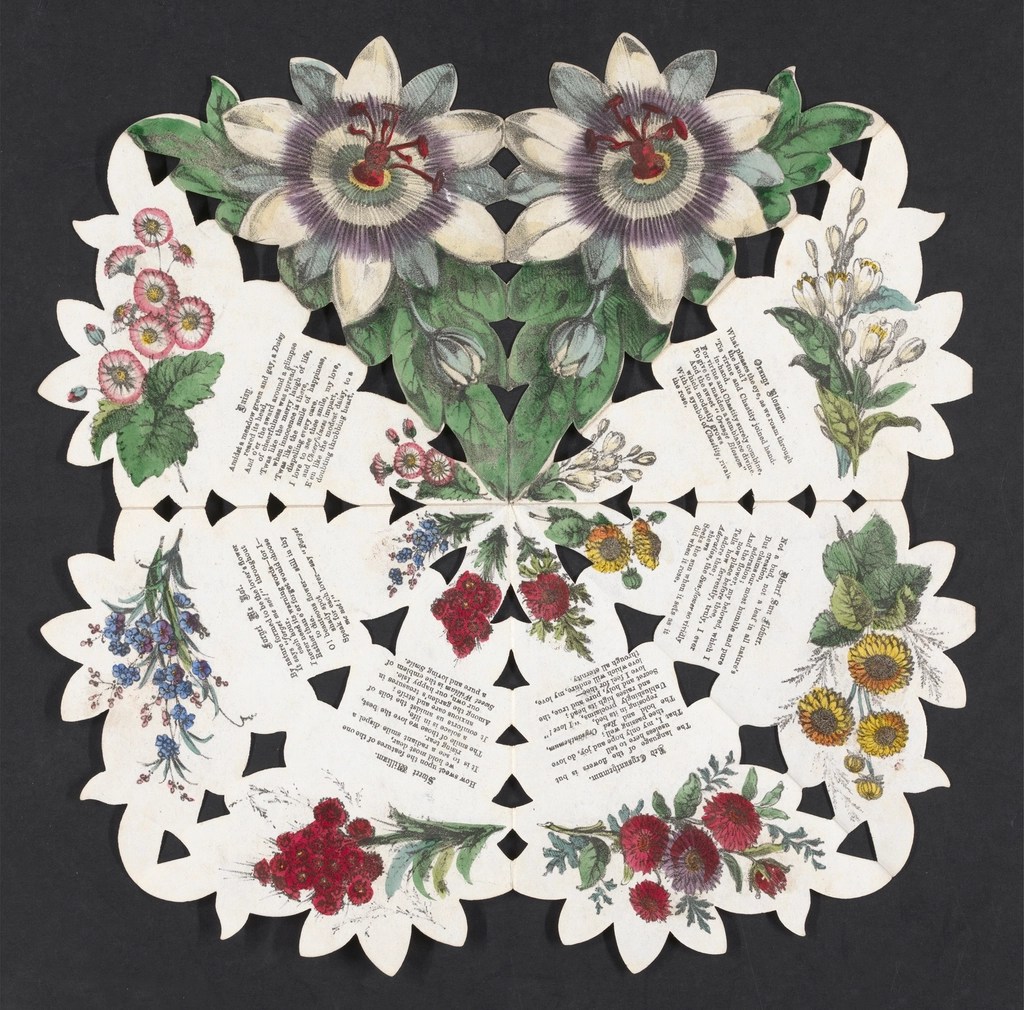
    The language of flowers“/ CC0 1.0
  • In the Presence of Absence by Mahmoud Darwish

    Rating: 10/10

    My Thoughts:

    Mahmoud Darwish is a skillfull poet. In his final work, all the experience he accumulated throughout his lifetime add up to this masterpiece. Beautiful, unique, sensitive.

    Quotes:

    “Letters lie before you, so release them from their neutrality and play with them like a conqueror in a delirious universe.”

    “All letters are ready to receive the form / being in search of a skillfil hadn to create the need for harmony.”

    “How can the sea be imprisoned in three letters, the second of which overflows with salt? How can letters take on so many words? How can words have enough space to embrace the world?”

    “They called you the dreamer because you so often gave words wings invisible to grown-ups. You provoked the obscure and became a stranger.”

    “Grasp your own reality and grasp your name and learn how to write your own proof. You, you and not your ghost, were the one driven out into the night.”

    “You and you are not you at the same time. Your are divided into an interior that exists and an exterior that enters.”

    “You cried like never before. You cried with all your senses. You cried as if you were not crying, but melting all at once and raining.”

    “You wonder, as someone else has: Are we what we do with time, or are we what time does with us? Finding a response does not interest you as much as slowing down time. You do not want this autumn to end, just as you do not want the poem to grow to fullness and end. You do not want to reach winter. Let autumn be your private eternity.”

    “You pause for a long time beofre an iris that sprang up alone, nowhere near a pot. Not because, like you, it is a stranger among flowers, but because it relies on itself in growing on its own.”

    “Cities are smells: Acre is the smell of iodine and spices. Haifa is the smell of pine and wrinkled sheets. Moscow is the smell of vodka on ice. Cairo is the smell of mango and ginger. Beirut is the smell of the sun, sea, smoke, and lemons. Damascus is the smell of jasmine and dried fruit. A city that cannot be known by its smell is unreliable. Exiles have a shared smell: the smell of longing for something , a smell that remembers another smell”

    “To the obscure: the pastime that turned into a profession and the profession that never stopped being a pastime.”

    “When asleep, you are your own overlord and sovereign. Alive, but without life`s burdens. Alive in a metaphorical death chosen with the care of an angel to train the body for the visit of the invisible in a mutually befitting form.”

    “Ever you set pen and paper nearby as a trap to catch the dream, the dream became fearful of being penned. Perheps because it does not want to be penned or summoned on command, you must not wait for it the way you wait for inspiration. It will come like a sovereign, without permission, as does love.”


    “You realized what you had never realized before. Death does not pain the dead, it pains the living.”

    “Longing is the absent chatting with the absent.”

    “Thus, longing is born from every beautiful incident and not from a wound. Longing is not a memory, but rather what is selected from memory`s musuem. […] It is the replaying of a memory after its blemishes have been removed.”

    “Love, like meaning, is out on the open road, but like poetry, it is difficult. It requires talent, endurance, and skillful formulation, because of its many stations.”

    “So do you know how to love? You cannot answer, perhaps because you did not notice the subtle atmospheric shifts when traveling from pole to pole: love and passion, rapture and infatuation, ardor and affection, fondness and devotion, blazing love and bewildering love, craving and caprice, dalliance and desire, longing and lust, admiration and attraction, and other desires in search of senses. […] So you never know where or how you are.”

    “Gaza is pride taking pride in its name, unceasingly provoked by the world`s silence before its long siege.”

    “You wonder: What kind of a linguistic or legal wunderknd could formulate a piece treaty and good neighborliness between a palace and a shack, between a guard and a prisoner?”

    “You walk down the alleys ashamed of everything: your ironed shirts, aesthetics of poetry, the abstractness of music, and a passport that allows you to travel the world. You are stabbed by a pain in your consciousness.”

    “You said to me: Love is neither happiness nor misery, but rather the senses finding the harmony and discord of resemblance through everrenewing desire.”

  • How to Live by Derek Sivers

    Rating: 9/10

    My Thoughts

    Derek Sivers is one of my favourite internet people. In his book he offers 26 mutually mostly exclusive ways to live your life. Many elements resonated on a deeper level with me, while others sounded very wrong. Use this book as a compass and follow the elements that ring true to you. Rereading this book makes sense. You are not static and neither is your reaction to these elements. I have written down the elements that I mostly agree with. There is no right way to live your life – neither is there a wrong one.


    Summary

    “Be independent: All misery comes from dependence, the only way to be deeply happy is to cut all dependencies, most problems are interpersonal, you have to detach from society”

    • Live as if you were the only person on earth”
    • Cut ties with society don`t engage. Norms, news, politics are not real. They are interpersonal drama. Don`t be a part of any group.
    • Instead of standing out from the crowd, avoid the crowd.
    • Stay unlabeled and unbound.
    • Rules and norms were created by upperclass to see who belongs to which class.

    “You can`t be free without self-mastery”:

    • Quit a harmless habit for a month, just to prove you can.
    • When you say you need freedom from yourself, you need freedom from your past self.
    • Learn the skills you need to be self-reliant. Assume nobody will help you. Don`t depend on any company.
    • Live where you feel most free.
    • Be a nomadic minimalist.
    • Spread different aspects of your life across different countries.

    “The problem is a lack of commitment”

    • No choice is inherently best, you make it best through your commitment to it.
    • Pick one choice and irreversibly commit, so it becomes the best choice.
    • Thoughts are divided, indecision keeps you shallow.
    • Focus your attention on the few things you are committed to.
    • Find a community of like-minded people.
    • Invite your neighbours over for a meal. The more social ties we have, the happier we are.
    • Marry someone full of kindness, you don`t want to change, who sees you as your highest potential.
    • When you commit you feel free.

    “Fill your senses”:

    • Appreciate the physical world.
    • Maximise your inputs, see all the places, meet all the people, be insatiable. Life is short.
    • Never do anything twice.
    • Follow guides, be systematic.

    “Make great adventures and greater stories”

    • Make a stagename and a company with the same name.
    • Record everything on video and make everything a story.
    • Keep momentum and repeat this process as much as you like.
    • Push it as far as it goes.

    “Live for the future”

    • Listen only to new music. Use only the newest media.
    • Stay only immersed in what is coming next.
    • Spend your social time in meeting new people.
    • Old friends and family will unintentionally keep you from growing.
    • Tradition is the opposite of what you want.

    “Value only what has endured”

    • The longer something lasts the longer it will last.

    “Learn as much as you can”

    • Confidence is usually ignorance.
    • Have questions, not answers. Doubt everything.
    • When you are really learning, you feel stupid and vulnerable.
    • Whatever scares you, go do it.
    • Get to know people you don`t usually talk to.
    • Great public speaking comes from great private thinking.

    “Love”

    • Sharing and learning is connecting and loving.
    • When someone tells you whats broken, they want you to love the brokenness not to heal them.
    • Keep communicating instead of shutting down.
    • Who makes you feel more like yourself, more open and honest?

    “Create”

    • Either consume or create.
    • Don`t wait for inspiration.
    • It`s better to create something bad than nothing.
    • Embrace whats weird about you and use it to create.
    • Don`t just express yourself but discover yourself.
    • Explore what excites you the most.
    • Imitate your heroes.

    “Quotes”

    • “The more you really connect with people, the more you learn about yourself: What exites you, what drains you, what attracts you, and what intimidates you.”
  • This is Marketing by Seth Godin

    You should read this book if you:

    Seek to create anything. It shifted my perspective on how marketing can be defined. This book is full of little gold nuggets of practical wisdom.

    Summary (9.5/10)

    If you see a way to make things better, than you have a marketing problem.

    The best way to complain is to make things better. Better is what happens when culture absorbs our work.

    Marketers make things better by making change happen.

    Make products for the customer you seek.

    Build something people would miss if it was gone.

    Marketing in 5 steps:

    1. Invent a thing worth making with a story worth telling and a contribution worth talking about.
    2. Design it and produce it in a way that a few people really care about.
    3. Tell a story that matches the built narrative and dreams of this tiny group of people.
    4. Spread the word.
    5. Often overlooked: Show up regularly for years to organise and lead for change to make and for enrollment to teach.

    Persistent, consistent and frequent stories will earn you trust.

    Culture beats strategy, because culture is strategy.

    People don`t want what you make, they want how it will make them feel.

    Most desired emotions: feeling safe and respected.

    Humans are lonely, they want to be known and seen. We create experiences. Each of the steps is part of the experience.

    The smallest viable market

    Be very specific of the change you want to make. If you had to choose 1000 people as your fans, who would you choose?

    Find a corner of the market that can`t wait for you. Overwhelm this group with your attention, care and focus. Make change that is so profound people can not help but notice.

    Loving you is a way of expressing yourself. That becomes part of their identity.

    Everyone is lonely, insecure and a bit of a fraud and afraid. Everyone has an impulse to connect and to contribute. It is so much more productive to dance together.

    Always be connection, testing and seeking.

    Find the things that you engage with trust. Find the essential parts that matter and weave them together into something new.

    If you can`t succeed in the small, why would you in the big.

    1000 true fans might be sufficient to live a more than normal life. They will spread the word to those around them.

    How to be succesfull: Focus all your energy on a small number of people. Have the guts to be quirky.

    Seek advice instead of feedback. Ask how you can make this thing fit more to the worldview of your audience. Plenty of people can tell you how your work made them feel.

    Those people that don`t buy from you, why are they right?

    Most poeple change their behavior to fit in and for status, affiliation and dominance. It takes tension to change them.

    Normalisation creates culture and culture creates change. Marketers create change by normalising new behavior. Be brave enough to just pick one culture you want to change.

    Being the one who establishes the next phase takes a leap, just a bit better and a little different than expected. Leap too far though and people won`t follow.

    Every member is people like us, sign up for that and you gain status. Begin with an exclusive cohort.

    Intentionally create little bits of tension, the reason is status.

    Fashion is usually about affiliation. The goal is to be part of a story.

    The only reason you launch something is because you want to make change. They want to know why.

    People will ask what does it remind me off and then act accordingly. The form changes the product sound.

    Pick a logo and keep it forever. Be willing to treat different people differently. Some people want to bargain, some will send more just because they can. Some want to talk about this, give them something to talk about.

    All the story telling you do requires frequency. If you quit in the middle of it, there was no time to earn trust.

    Price is a story

    People form assumptions based on your price, important to be clear on how you position yourself. When you are the cheapest you are selling cheaper, not change.

    Permission marketing is your biggest asset.

    What is your purple cow (something worth talking about)?

    The Funnel

    Trust is not static. You can remove steps so that fewer decisions are required. Create tension to create forward motion. Hand those who successfully engaged in the funnel a megaphone.

    Give people a network effect. What will I tell my friends and why? This usually involved changing what you have to offer.

    The Tribe

    It is not yours. If you invest in them, they will show you what they want and need. The goal is for them to miss you.

    Manipulation is the tribe killer. Put people to work, challenge them to explore and learn to be uncomfortable with uncertainty.

    Celebrate your people, invite everyone along.

    Tribe = People share interests and goals. These members are lonely and disconnected, they fear not being seen. You can make connection happen. Intentionally create cultural artefact. Best marketers are farmers, not hunters.

    The best work will create an imbalance in the viewer. This forces the word to spread. “Have you seen…?” will raise the status of the asker. The connection that you make matters.

    Do the hard work of deciding this is your calling.

    Marketing works and now is your turn. “Perfect” forbids us to try. The magic of “good enough” leads to engagement and trust. Ship your work if it is not good enough, then make it better. Market something you are proud of